
Survodutide was designed to combine the anorectic and insulinotropic effects of GLP-1 with the thermogenic and energy expenditure–enhancing actions of glucagon. This dual activity results in:
• Reduced food intake via central mechanisms
• Improved glucose-dependent glycemic control
• Increased lipid oxidation
• Elevated basal energy expenditure
Structurally, it is a modified peptide with strategic amino acid substitutions and chemical extensions that enhance plasma stability and resistance to enzymatic degradation, enabling extended-interval subcutaneous administration.
Unlike selective GLP-1 agonists, Survodutide leverages the synergistic effect between satiety and thermogenesis, promoting significant reduction in body fat, including hepatic fat, as observed in clinical studies.
Important Information
| Properties | Value |
| Molecular Formula | Not publicly disclosed in a standardized form |
| Molecular Weight | ≈ 4.5 – 5.0 kDa |
| Synonyms | Survodutide, BI 456906 (development code), Dual GLP-1/Glucagon agonist |
Main Structure of the Survodutide Peptide
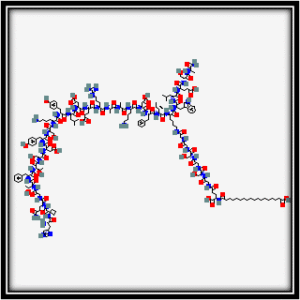
Fonte: PubChem
Scientific Summary
Survodutide is a dual GLP-1/glucagon peptide agonist that promotes body fat loss by reducing caloric intake and increasing energy expenditure, with additional effects on hepatic metabolism and glycemic control. Its integrated mechanism positions it as an advanced metabolic approach for obesity and adiposity-related diseases.
Lyophilized Peptides
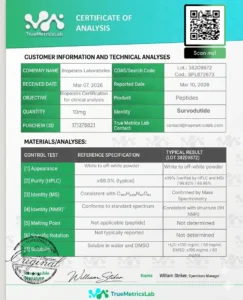
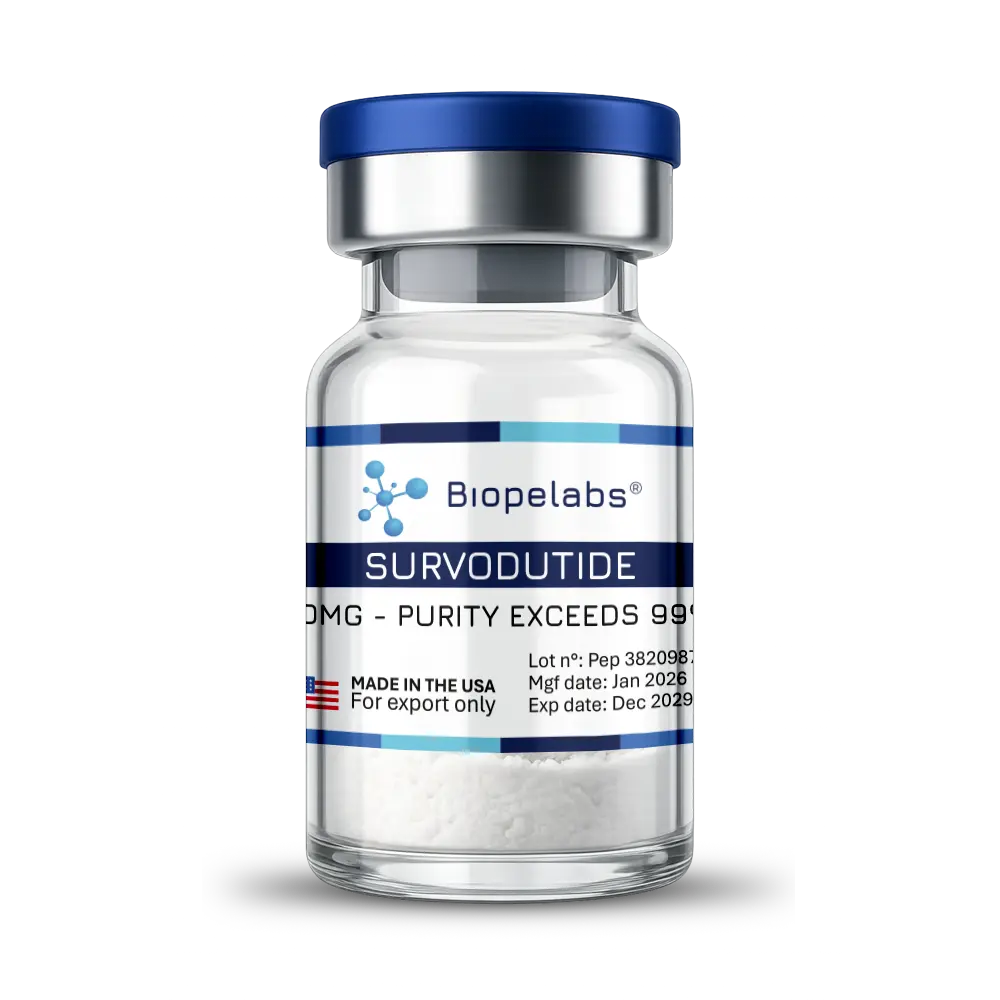
The peptides undergo a lyophilization process, a technique that enhances stability and shelf life while preserving purity and molecular structure during storage. Notably, no fillers are used in this procedure.
Intended Use
Biopelabs warns: this material is provided exclusively as a chemical reagent for research purposes. Its use is restricted to in vitro assays and experimental activities in a laboratory setting. The information provided is strictly informational and educational. Handling must be performed only by qualified professionals. The product is not classified as a medicine, food, or cosmetic and must not be used, marketed, or described as such.
Initial Comments on the Peptide/Presentation
Survodutide (BI 456906), developed by Boehringer Ingelheim and Zealand Pharma, is a non-proteolytic dual peptide agonist of the GLP-1 (glucagon-like peptide-1) and glucagon (GCG) receptors. Structurally, it comprises a semaglutide derivative with modifications for dual agonism, including a C20 acylator to extend plasma half-life. Designed for obesity and non-alcoholic steatohepatitis (NASH) treatment, it stands out for its potency in preclinical and phase 2/3 clinical models, administered subcutaneously weekly.
Mechanism of Action and Inhibition
Survodutide simultaneously activates GLP-1R and GCGR, inhibiting glucagon secretion via GLP-1R in pancreatic α-cells while stimulating lipolysis and thermogenesis via GCGR in liver and adipose tissue. In the liver, it promotes controlled glycogenolysis and gluconeogenesis, reducing triglyceride accumulation through upregulation of β-oxidation pathways. Additionally, it suppresses appetite via hypothalamic GLP-1R signaling and increases basal energy expenditure by activating UCP1 in brown adipose tissue. Its DPP-4 resistance preserves prolonged endogenous activity.
Scientifically Investigated Metabolic Impacts
Phase 2 clinical studies (Liviia-1 and Liviia-2) demonstrate mean body weight reductions of 19-24% after 46 weeks in obese patients (BMI >30 kg/m²), with >40% visceral fat loss via DEXA and MRI. In NASH, it resolves hepatic fibrosis in 50-60% of cases (FIB-4 score) and reduces steatosis by >70%, as measured by multiparametric MRI. It improves glycemic control (HbA1c -1.5% to -2.0%) without significant hypoglycemia and elevates HDL-cholesterol while lowering triglycerides. Animal models confirm 25-30% increases in total energy expenditure.
Specific Action of Survodutide Peptide
Survodutide exhibits a specific beneficial action in regressing advanced hepatic fibrosis in NASH, with phase 2 trials showing histological resolution (NAS scale) in 83% of participants versus 20% on placebo. This stems from its dual agonism, synergizing hepatic lipid reduction (GCGR) with anti-inflammation (GLP-1R), positioning it as a leading candidate for chronic metabolic liver diseases.
Pharmacokinetic Considerations in Research
In humans, survivodutide shows a T_max of 2-4 hours post-subcutaneously, with a terminal half-life of ~170 hours, enabling weekly dosing (2.4-4.8 mg). Bioavailability ~90%, with predominant hepatic clearance via CYP3A4 and biliary excretion. Studies in cirrhotics (Child-Pugh B/C) indicate 50-100% elevated AUC, recommending slow titration. It does not accumulate significantly in obese individuals, with Vd of 10-15 L/kg.
Final Considerations
Survodutide represents a paradigm shift in dual peptide therapies for obesity and NASH, with a favorable safety profile (transient nausea as the primary AE). Ongoing phase 3 trials (Liviia-3/4, Nazali-1) will confirm efficacy in broader populations, potentially leading to regulatory approval by 2027. Future research should explore combinations with SGLT2i and long-term cardiovascular impacts.
References
Only logged in customers who have purchased this product may leave a review.
| Weight | 40 g |
|---|---|
| Dimensions | 7 × 3,6 × 8 cm |



Reviews
There are no reviews yet.