
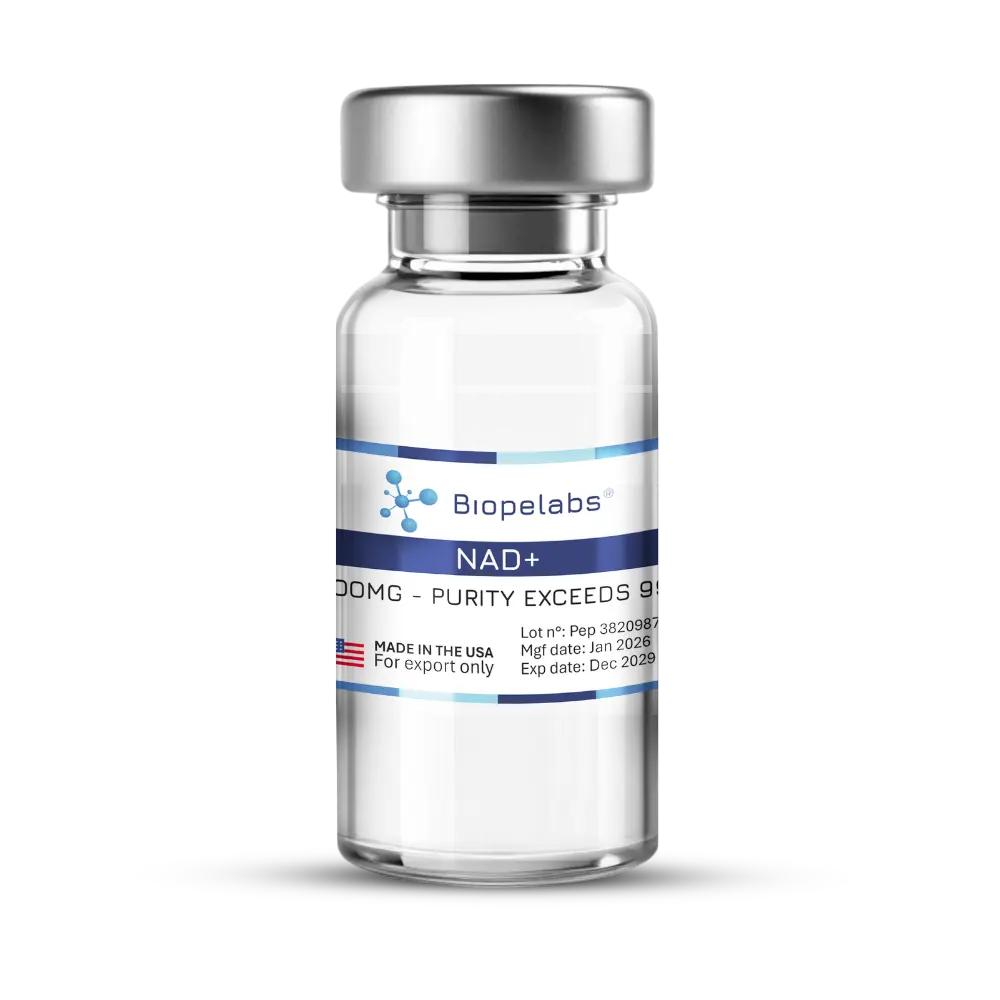
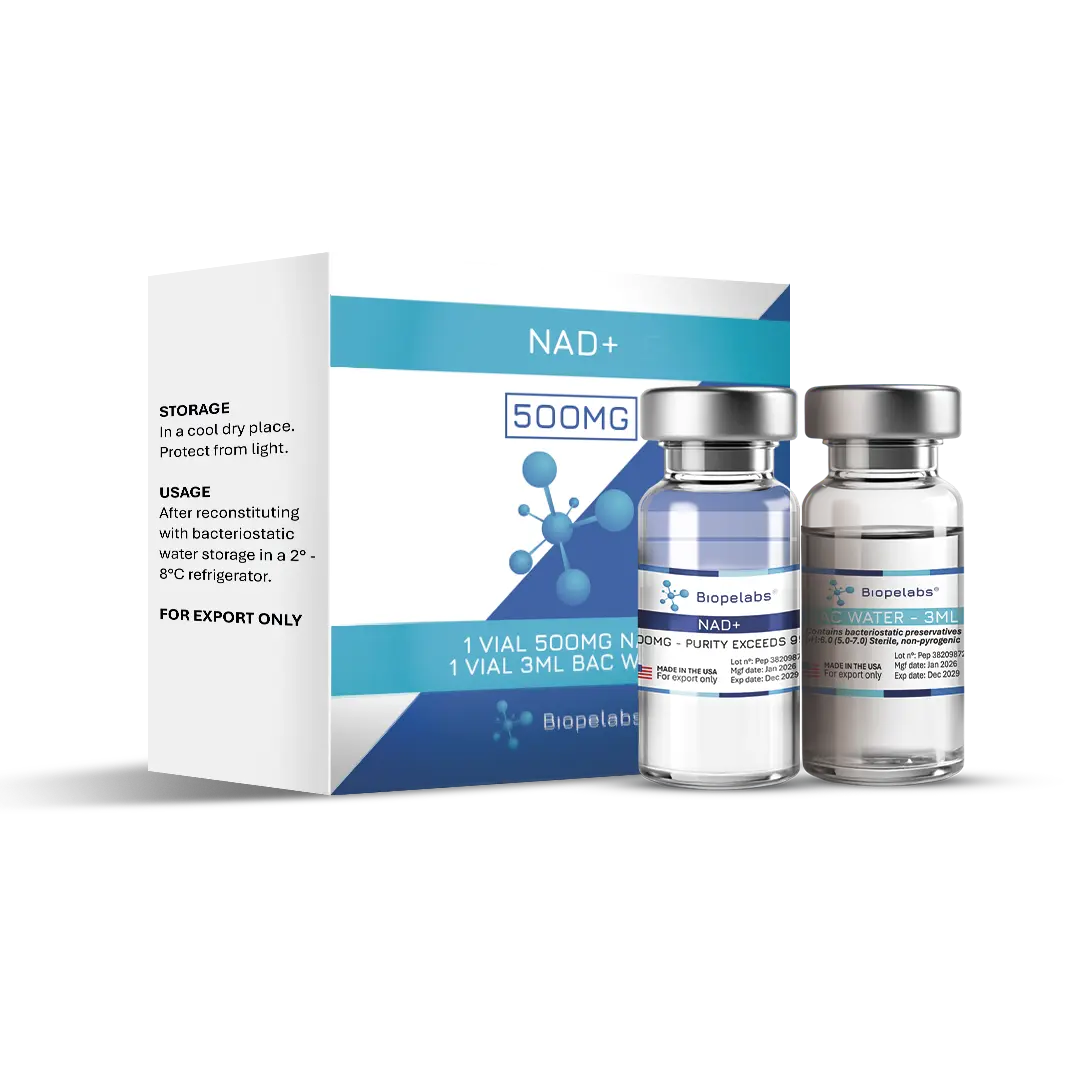
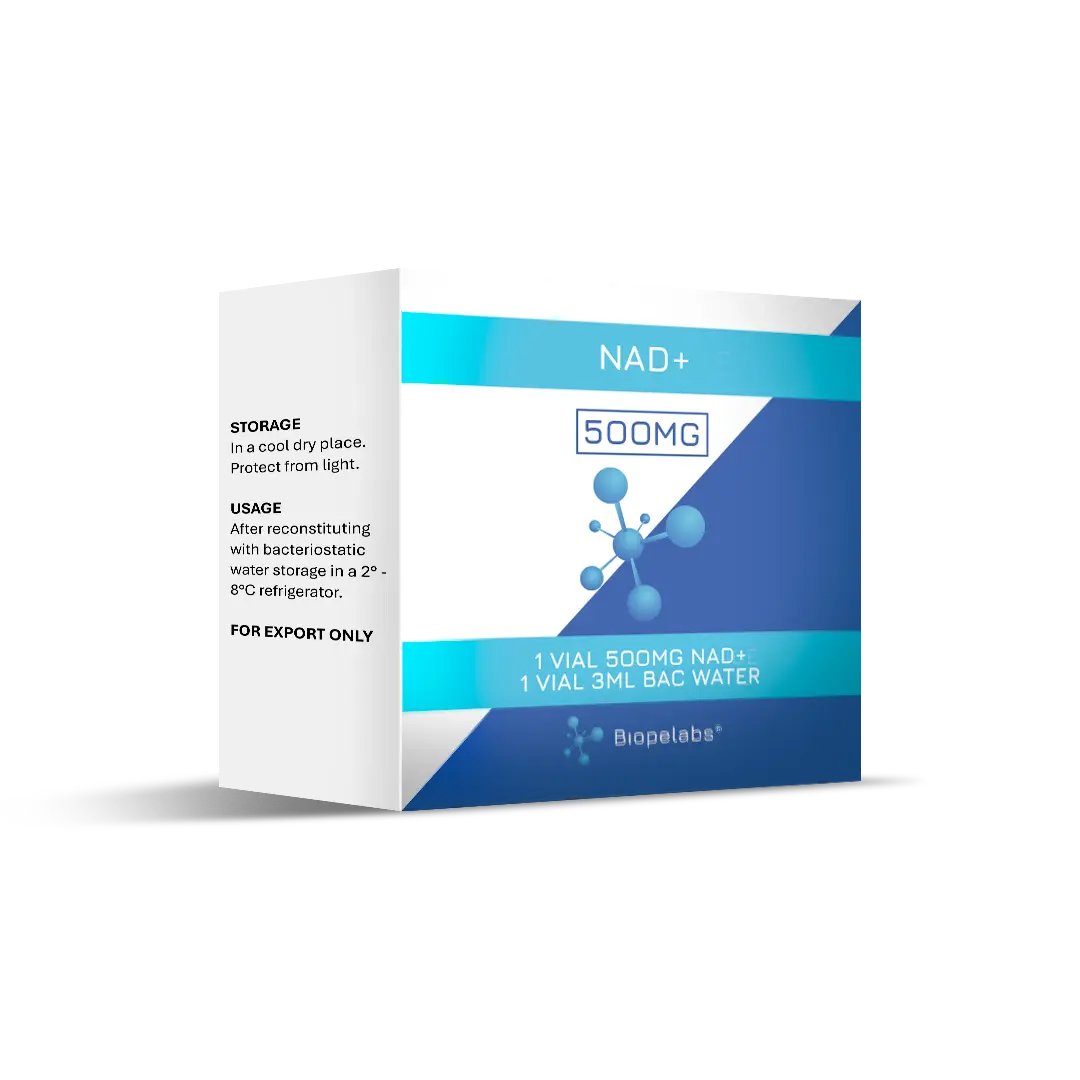


NAD+ is a coenzyme involved in redox reactions and cellular metabolism. It has gained attention for its role as a signaling molecule, influencing processes such as energy metabolism, cellular survival, and aging.
NAD+ levels decline with age, leading to metabolic alterations and increased susceptibility to disease, which has driven interest in molecules that boost NAD+ levels to improve health and longevity.
| Properties | Value |
| Molecular Formula | C21H27N7O14P2 |
| Molecular Weight | 663.43 g/mol |
| Synonyms: | 53-84-9, beta-nicotinamide adenine dinucleotide, Endopride, alpha-diphosphopyridine nucleotide, 7298-93-3 |
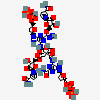
Source: PubChem
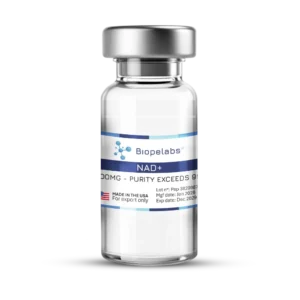
The peptides undergo a lyophilization process, a technique that contributes to greater stability and durability while preserving purity and molecular structure during storage. It is important to note that no fillers are used during this process.
Biopelabs advises: this material is provided exclusively as a chemical input for research purposes. Its use is restricted to in vitro assays and experimental activities in laboratory settings. The information presented is strictly for informational and educational purposes. Handling must be carried out only by properly qualified professionals. The product is not classified as a medication, food, or cosmetic, and must not be used, marketed, or described as such.
NAD+ plays a crucial role in redox reactions and serves as a cofactor for numerous enzymes, including sirtuins and poly(ADP‑ribose) polymerases (PARPs). This coenzyme is essential for cellular processes involving metabolism, DNA repair, and chromatin remodeling, all of which are critical for maintaining tissue homeostasis and overall metabolic balance. With advancing age, a decline in NAD+ levels is observed, which may contribute to age‑related diseases such as cognitive impairment, cancer, and metabolic disorders.
NAD+ plays an important role in aging and longevity. Studies suggest that restoring NAD+ levels in older or diseased organisms can improve health and extend lifespan. This has led to growing interest in NAD+ precursors such as nicotinamide riboside (NR) and nicotinamide mononucleotide (NMN), which have shown beneficial potential in age‑related pathologies.
The enzyme CD38, an NADase, is key to understanding age‑related NAD+ decline. Inhibition of CD38 by specific compounds such as 78c has yielded promising results in reversing the NAD+ decline and improving metabolic and physiological parameters in aging models. These effects include enhanced glucose tolerance as well as improved muscle function and cardiovascular performance. By elevating NAD+ levels, longevity‑promoting factors such as sirtuins and AMPK are activated, whereas pathways that negatively impact lifespan, such as mTOR‑S6K, are inhibited. This pharmacological approach highlights the possibility of modulating NAD+ metabolism to prevent or reverse aging‑associated dysfunctions.
Alterations in NAD+ metabolism are closely associated with the onset of metabolic disorders, including diabetes, obesity, and non‑alcoholic fatty liver disease. NAD+ levels tend to decrease with aging and in conditions of nutritional imbalance, thereby exacerbating these problems. An imbalance in the NAD+/NADH ratio can lead to inadequate cellular responses to stress and multiple metabolic dysfunctions characteristic of metabolic diseases.
Aging and metabolic stress are linked to a reduction in NAD+ levels, which can result in mitochondrial dysfunction and increased susceptibility to cardiovascular diseases. This decline is associated with major risk factors such as obesity and hypertension, which intensify the development of conditions like atherosclerosis and cardiomyopathies. The progressive loss of NAD+ over time or under stress conditions underscores the need to maintain adequate NAD+ levels to prevent cardiovascular dysfunction.
NAD+ participates in redox reactions and signaling‑dependent processes that are fundamental for mitochondrial function and for reducing oxidative stress, a common feature in neurodegenerative diseases. Activation of NAD+‑dependent pathways can enhance cellular resilience against oxidative damage, which is crucial for neuronal health. Furthermore, NAD+ plays a role in maintaining axonal integrity and viability, making its metabolism an attractive target for therapeutic strategies in neurological conditions.
Studies show that increasing NAD+ availability can improve mitochondrial function and reduce neuroinflammation, as demonstrated in models of diseases such as Parkinson’s, Alzheimer’s, and amyotrophic lateral sclerosis (ALS). In these models, improved NAD+ levels have contributed to better mitochondrial function and enhanced cognitive and synaptic performance. The Sirt1/PGC‑1α pathway is one of the mechanisms through which NAD+ exerts its protective effects, highlighting its potential as a therapeutic target.
NAD+ metabolism is closely tied to mitochondrial function. NAD+ serves as a substrate for sirtuins, which are enzymes that regulate mitochondrial homeostasis. Elevated NAD+ levels and sirtuin activation have been associated with improved mitochondrial function and overall metabolism, as well as beneficial effects on longevity across multiple species.
The origin and intramitochondrial transport of NAD+ have been the subject of considerable debate. Recent research has identified SLC25A51 as an essential NAD+ transporter in mammalian mitochondria, playing a key role in maintaining mitochondrial NAD+ levels and respiratory function. De novo NAD+ synthesis has also been shown to benefit mitochondrial function, with enzymes such as ACMSD critically regulating NAD+ levels and sirtuin activity.
Cancer cells display a peculiar metabolic pattern known as the Warburg effect, characterized by increased glycolysis even in the presence of oxygen, a process sustained by elevated NAD+ levels. The NAD+ regeneration pathway is especially important in cancer cells, as it becomes their primary route for NAD+ synthesis, and its inhibition can trigger cell death in tumor cells.
NAD+ metabolism is not only relevant in cancer cells but also influences the tumor microenvironment. NAD+ and its metabolites can affect immune responses, contributing to an immunosuppressive microenvironment. Enzymes such as CD38, which consume NAD+, are involved in producing metabolites that suppress immunity, thereby further impacting cancer progression and immune evasion.
Targeting NAD+ metabolism represents a promising strategy for cancer treatment. Inhibitors of NAD+ biosynthesis, particularly those targeting nicotinamide phosphoribosyltransferase (NAMPT), have shown promise in preclinical models, although resistance due to alternative NAD+ biosynthetic pathways may limit their efficacy.
Rajman, L., Chwalek, K., & Sinclair, D. (2018). Therapeutic potential of NAD‑boosting molecules: The in vivo evidence… Cell Metabolism, 27(3), 529–547. https://doi.org/10.1016/j.cmet.2018.02.011
Tarragó, M., Chini, C., Kanamori, K., Warner, G., Caride, A., De Oliveira, G., Rud, M., Samani, A., Hein, K., Huang, R., Jurk, D., Cho, D., Boslett, J., Miller, J., Zweier, J., Passos, J., Doles, J., Becherer, D., & Chini, E. (2018). A potent and specific CD38 inhibitor ameliorates age‑related metabolic dysfunction by reversing the decline in tissue NAD+. Cell Metabolism, 27(5), 1081–1095.e10. https://doi.org/10.1016/j.cmet.2018.03.016
Okabe, K., Yaku, K., Tobe, K., & Nakagawa, T. (2019). Implications of altered NAD metabolism in metabolic disorders. Journal of Biomedical Science, 26. https://doi.org/10.1186/s12929‑019‑0527‑8
Amjad, S., Nisar, S., Bhat, A., Shah, A., Frenneaux, M., Fakhro, K., Haris, M., Reddy, R., Patay, Z., Baur, J., & Bagga, P. (2021). Role of NAD+ in the regulation of cellular and metabolic signaling pathways. Molecular Metabolism, 49. https://doi.org/10.1016/j.molmet.2021.101195
Rotllan, N., Camacho, M., Tondo, M., Diarte‑Añazco, E., Canyelles, M., Méndez‑Lara, K., Benítez, S., Alonso, N., Mauricio, D., Escolà‑Gil, J., Blanco‑Vaca, F., & Julve, J. (2021). Therapeutic potential of emerging NAD+‑boosting strategies for cardiovascular diseases. Antioxidants, 10. https://doi.org/10.3390/antiox10121939
Abdellatif, M., Sedej, S., & Kroemer, G. (2021). NAD+ metabolism in cardiac health, aging, and disease… Circulation, 144(22), 1795–1817. https://doi.org/10.1161/CIRCULATIONAHA.121.056589
Lin, Q., Zuo, W., Liu, Y., Wu, K., & Liu, Q. (2021). NAD+ and cardiovascular diseases. Clinica Chimica Acta; International Journal of Clinical Chemistry. https://doi.org/10.1016/j.cca.2021.01.012
Pehar, M., Harlan, B., Killoy, K., & Vargas, M. (2017). Nicotinamide adenine dinucleotide metabolism and neurodegeneration… Antioxidants & Redox Signaling, 28(18), 1652–1668. https://doi.org/10.1089/ars.2017.7145
Alexandris, A., & Koliatsos, V. (2023). NAD+, axonal maintenance, and neurological diseases. Antioxidants & Redox Signaling, 39, 1167–1184. https://doi.org/10.1089/ars.2023.0350
Zhao, Y., Zhang, J., Zheng, Y., Zhang, Y., Zhang, X., Wang, H., Du, Y., Guan, J., Wang, X., & Fu, J. (2021). NAD+ improves cognitive function and reduces neuroinflammation by attenuating mitochondrial damage and decreasing ROS production in chronic cerebral hypoperfusion models via the Sirt1/PGC‑1α pathway. Journal of Neuroinflammation, 18. https://doi.org/10.1186/s12974‑021‑02250‑8
Katsyuba, E., Mottis, A., Ziętak, M., De Franco, F., Van der Velpen, V., Gariani, K., Ryu, D., Cialabrini, L., Matilainen, O., Liscio, P., Giacchè, N., Stokar‑Regenscheit, N., Legouis, D., De Seigneux, S., Ivanisevic, J., Raffaelli, N., Schoonjans, K., Pellicciari, R., & Auwerx, J. (2018). De novo NAD+ synthesis improves mitochondrial function and enhances health. Nature, 563, 354–359. https://doi.org/10.1038/s41586‑018‑0645‑6
Luongo, T., Eller, J., Lu, M., Niere, M., Raith, F., Perry, C., Bornstein, M., Oliphint, P., Wang, L., McReynolds, M., Migaud, M., Rabinowitz, J., Johnson, F., Johnsson, K., Ziegler, M., Cambronne, X., & Baur, J. (2020). SLC25A51 is a mammalian mitochondrial NAD+ transporter. Nature, 588, 174–179. https://doi.org/10.1038/s41586‑020‑2741‑7
Yaku, K., Okabe, K., Hikosaka, K., & Nakagawa, T. (2018). NAD metabolism in cancer therapy. Frontiers in Oncology, 8. https://doi.org/10.3389/fonc.2018.00622
Kennedy, B., Sharif, T., Martell, E., Dai, C., Kim, Y., Lee, P., & Gujar, S. (2016). NAD+ salvage pathway in cancer metabolism and therapy… Pharmacological Research, 114, 274–283. https://doi.org/10.1016/j.phrs.2016.10.027
Audrito, V., Managò, A., Gaudino, F., Sorci, L., Messana, V., Raffaelli, N., & Deaglio, S. (2019). NAD biosynthetic and NAD‑consuming enzymes as central players in metabolic regulation of innate and adaptive immune responses in cancer. Frontiers in Immunology, 10. https://doi.org/10.3389/fimmu.2019.01720
Myong, S., Nguyen, A., & Challa, S. (2024). Biological functions and therapeutic potential of NAD+ metabolism in gynecological cancers. Cancers, 16. https://doi.org/10.3390/cancers16173085
Ghanem, M., Caffa, I., Monacelli, F., & Nencioni, A. (2024). Inhibitors of NAD+ production in cancer treatment: State of the art and perspectives. International Journal of Molecular Sciences, 25. https://doi.org/10.3390/ijms25042092

The content was reviewed by Dr. Ky H. Le, MD. Dr. Ky H. Le is a family physician in Aiea, Hawaii. He received his medical degree from St. George’s University School of Medicine and has been practicing for over 20 years. He has expertise in the treatment of obesity, diabetes, hypertension, and high blood pressure, among other conditions—see all areas of specialization at https://health.usnews.com/doctors/ky‑le‑371599#expertise. Dr. Ky H. Le accepts Medicare, Aetna, Humana, Blue Cross, and United Healthcare.
Reference: https://health.usnews.com/doctors/ky‑le‑371599#expertise
Only logged in customers who have purchased this product may leave a review.
| Weight | 40 g |
|---|---|
| Dimensions | 7 × 3,6 × 8 cm |

Reviews
There are no reviews yet.