
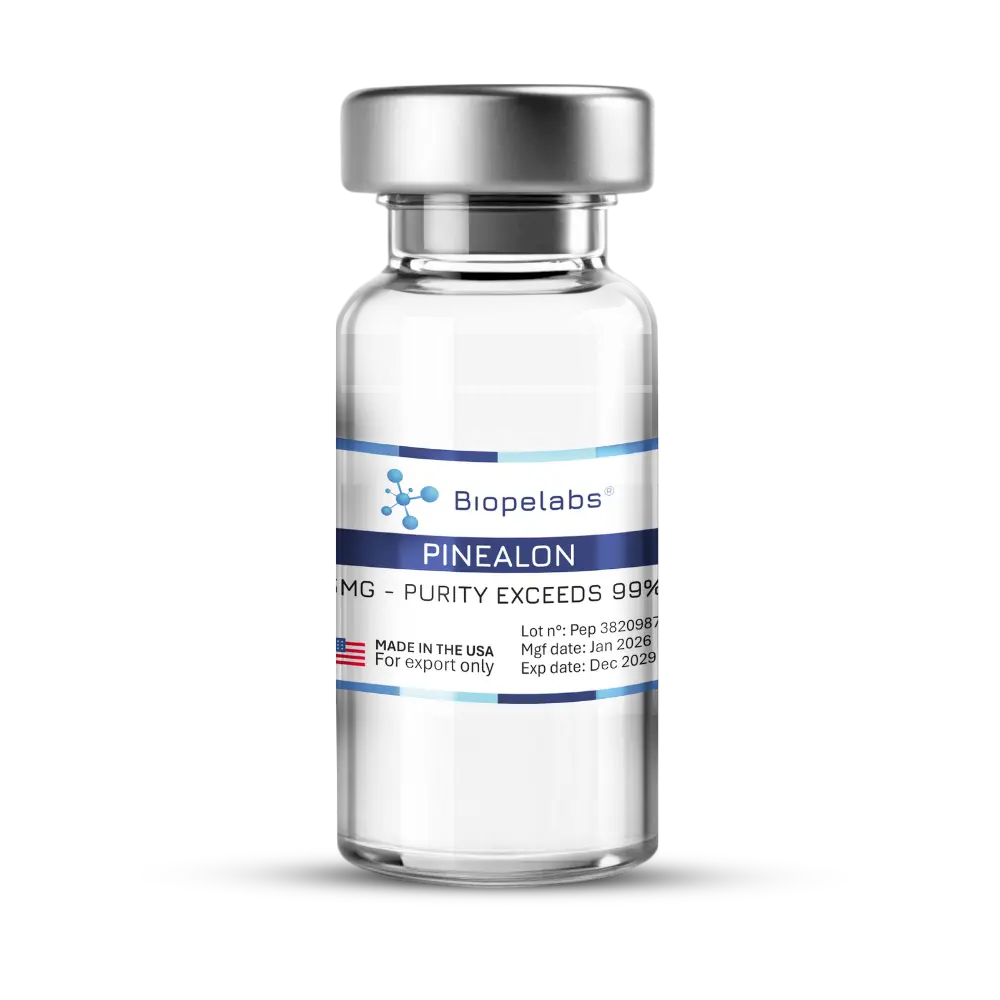
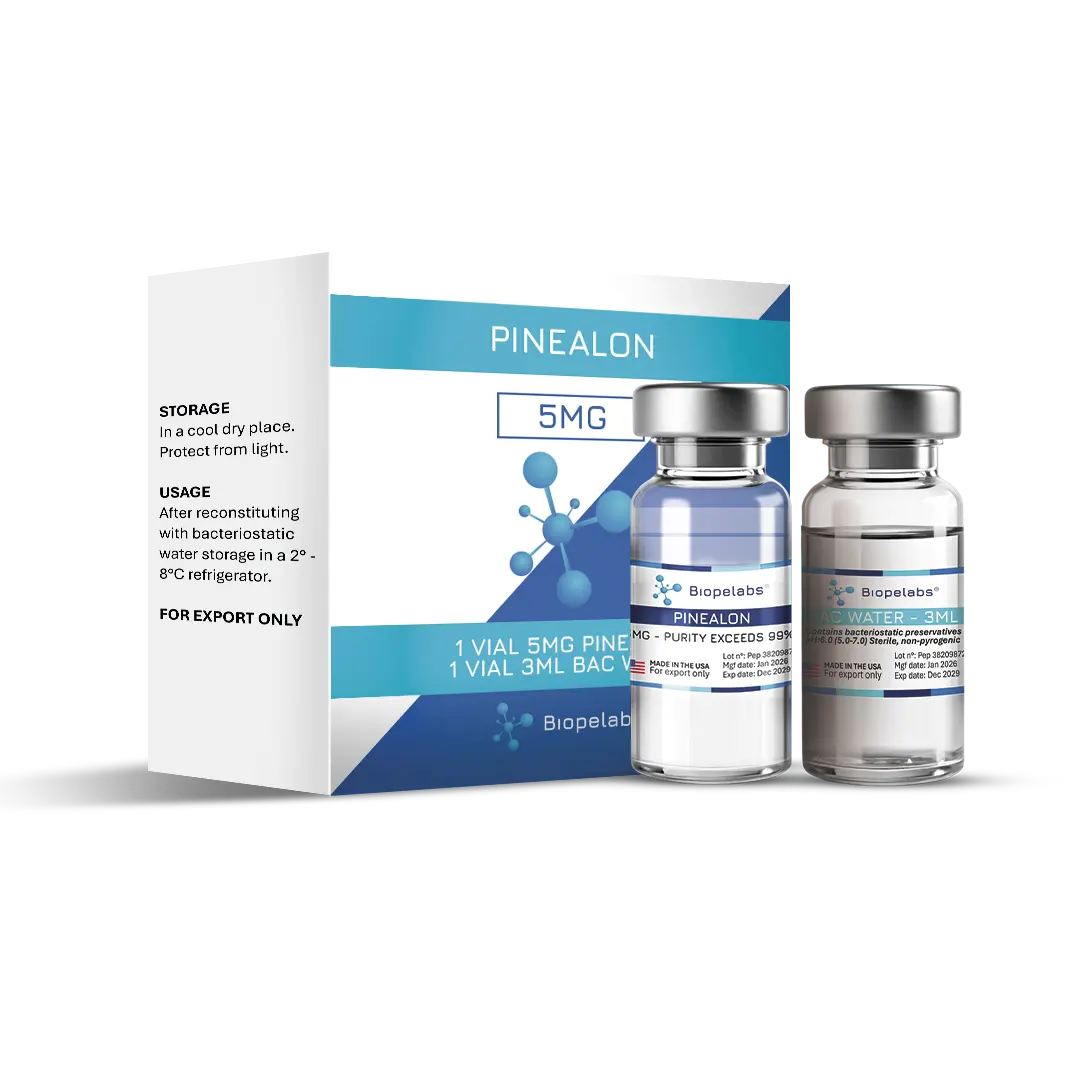
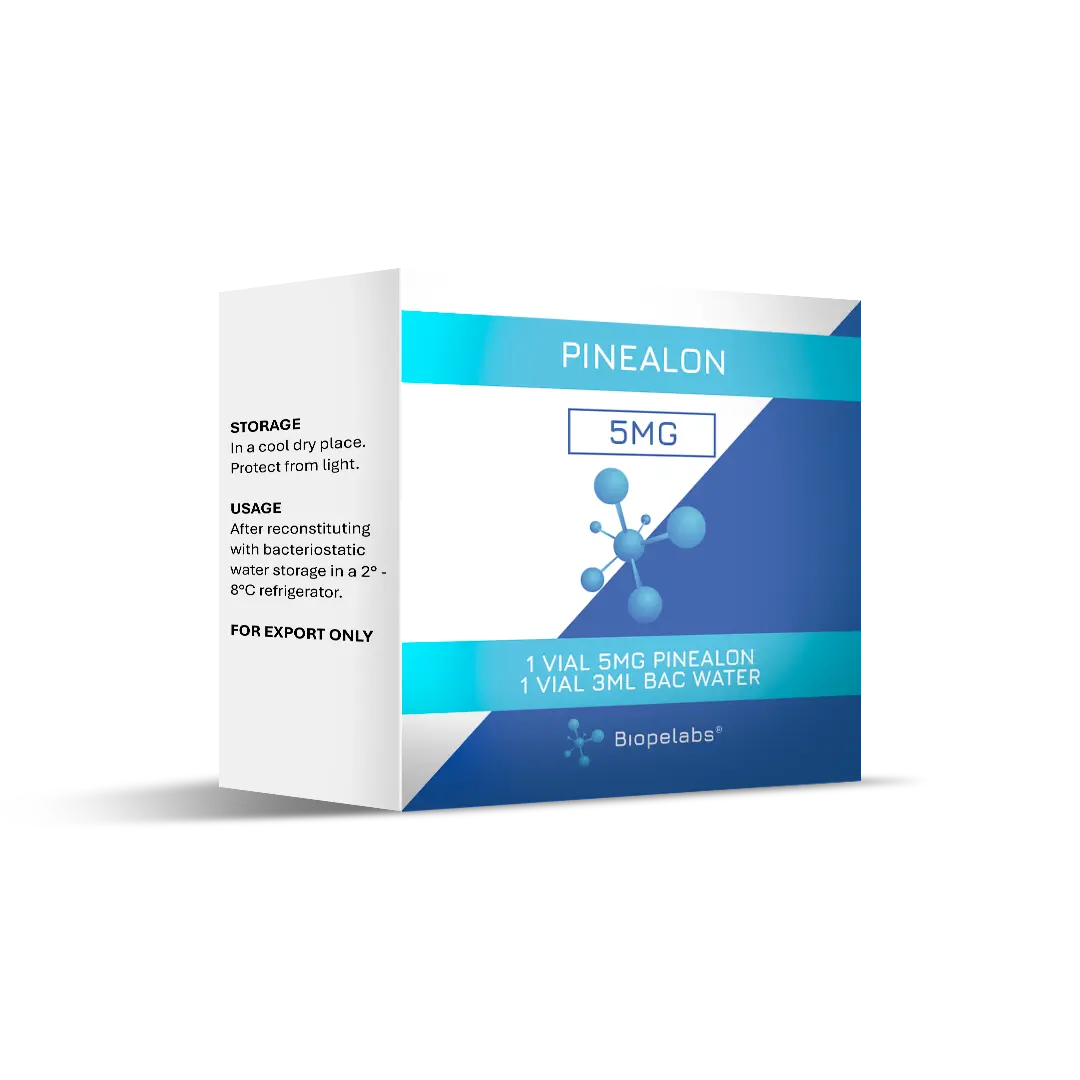


Pinealon is a synthetic tripeptide‑based bioregulator composed of the amino acids L‑glutamic acid, L‑aspartic acid, and L‑arginine (Glu‑Asp‑Arg / EDR). Classified as a cytogene, it interacts directly with DNA to modulate gene expression, distinguishing it from receptor‑dependent peptides. Developed within the Russian “bioregulator” concept as a neuroprotective agent, Pinealon acts on the pineal gland and the central nervous system with multimodal biological activity.
| Property | Value |
| Chemical formula | C₁₅H₂₆N₆O₈ |
| Molecular weight | 418.40 g/mol |
| Synonyms | Glutamylaspartylarginine, Glu‑Asp‑Arg, H‑Glu‑Asp‑Arg‑OH, L‑Glu‑L‑Asp‑L‑Arg, 175175‑23‑2 |
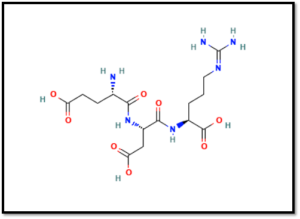
Fonte: PubChem
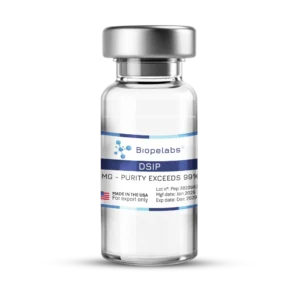
Pinealon, like other research peptides, is provided as a lyophilized powder. Lyophilization enhances stability and shelf life while preserving purity and molecular structure during storage. No fillers or bulking agents are added during this process.
Biopelabs advises: this material is provided exclusively as a chemical reagent for research purposes. Its use is restricted to in vitro assays and experimental work in a controlled laboratory setting. The information provided is strictly educational and informational. Handling must be performed only by qualified professionals. This product is not classified as a medicine, food, or cosmetic and must not be used, marketed, or described as such.
This document provides a technical overview of Pinealon, a synthetic tripeptide developed within the framework of peptide‑based bioregulation, with a focus on its action in the central nervous system (CNS) and in cellular‑aging mechanisms.
Pinealon is a synthetic tripeptide with the amino‑acid sequence Glu‑Asp‑Arg (glutamic acid‑aspartic acid‑arginine). It was developed at the Institute of Bioregulation and Gerontology in Saint Petersburg as a “short‑chain bioregulator.” The underlying concept is that short peptides can act as epigenetic signaling molecules, regulating gene expression and protein synthesis in specific tissues—in this case, the brain and pineal gland. Due to its low molecular weight, Pinealon readily crosses the blood–brain barrier and shows minimal immunogenicity.
Pinealon’s primary mechanism of action is epigenetic and neuroprotective.
Although its main action is central, Pinealon influences systemic homeostasis.
Pinealon’s investigation in oncologic models is closely linked to its classification as a geroprotector.
Pinealon (EDR) is positioned as a key research tool in the field of epigenetic‑precision medicine. Its ability to modulate brain function at the transcriptional level, without many of the side‑effect profiles of conventional psychotropic drugs, makes it a high‑interest candidate for studies on neurodegenerative disorders and age‑related cognitive decline.
Glu‑Asp‑Arg / glutamyl‑aspartyl‑arginine / L‑glutamyl‑L‑aspartyl‑L‑arginine (Pinealon)
Compound CID: 10273502
Molecular formula: C₁₅H₂₆N₆O₈
Molecular weight: 418.4 g/mol
IUPAC name:
(4S)‑4‑amino‑5‑[[(2S)‑3‑carboxy‑1‑[[(1S)‑1‑carboxy‑4‑(diaminomethylideneamino)butyl]amino]‑1‑oxopropan‑2‑yl]amino]‑5‑oxopentanoic acid
(Source: PubChem)
Khavinson, V. K., Linkova, N. S., & Diatlova, A. S. (2020). Peptides Regulate the Expression of Genes Involved in the Development of Alzheimer’s Disease. Bulletin of Experimental Biology and Medicine, 168. https://doi.org/10.1007/s10517‑020‑04731‑z
Khavinson, V. K., Tendler, S. M., & Vanyushin, B. F. (2014). Peptide Regulation of Gene Expression: A New Approach to Curative and Preventive Medicine. In: Epigenetics of Aging (pp. 299–316). Springer. https://doi.org/10.1007/978‑94‑017‑9153‑3_16
Lin’kova, N. S., Polyakova, V. O., & Khavinson, V. K. (2021). Pinealon and Brain Aging: Effects on Neurogenesis and Apoptosis. Advances in Gerontology, 11(2). https://doi.org/10.1134/S207905702102010X
Myong, S., Nguyen, A., & Challa, S. (2024). Biological functions and therapeutic potential of NAD+ metabolism in gynecological cancers. Cancers, 16. https://doi.org/10.3390/cancers16173085
(Note: The Pinealon‑related studies summarized above are consistent with the broader body of work described in Khavinson et al. and related bioregulator‑peptide literature.)
Only logged in customers who have purchased this product may leave a review.
| Weight | 40 g |
|---|---|
| Dimensions | 7 × 3,6 × 8 cm |

Reviews
There are no reviews yet.